
‘The rimshots come down like cannon fire and thunder off the wall / There’s a man in every corner / And each one is giving his all.’ – Mark Knopfler
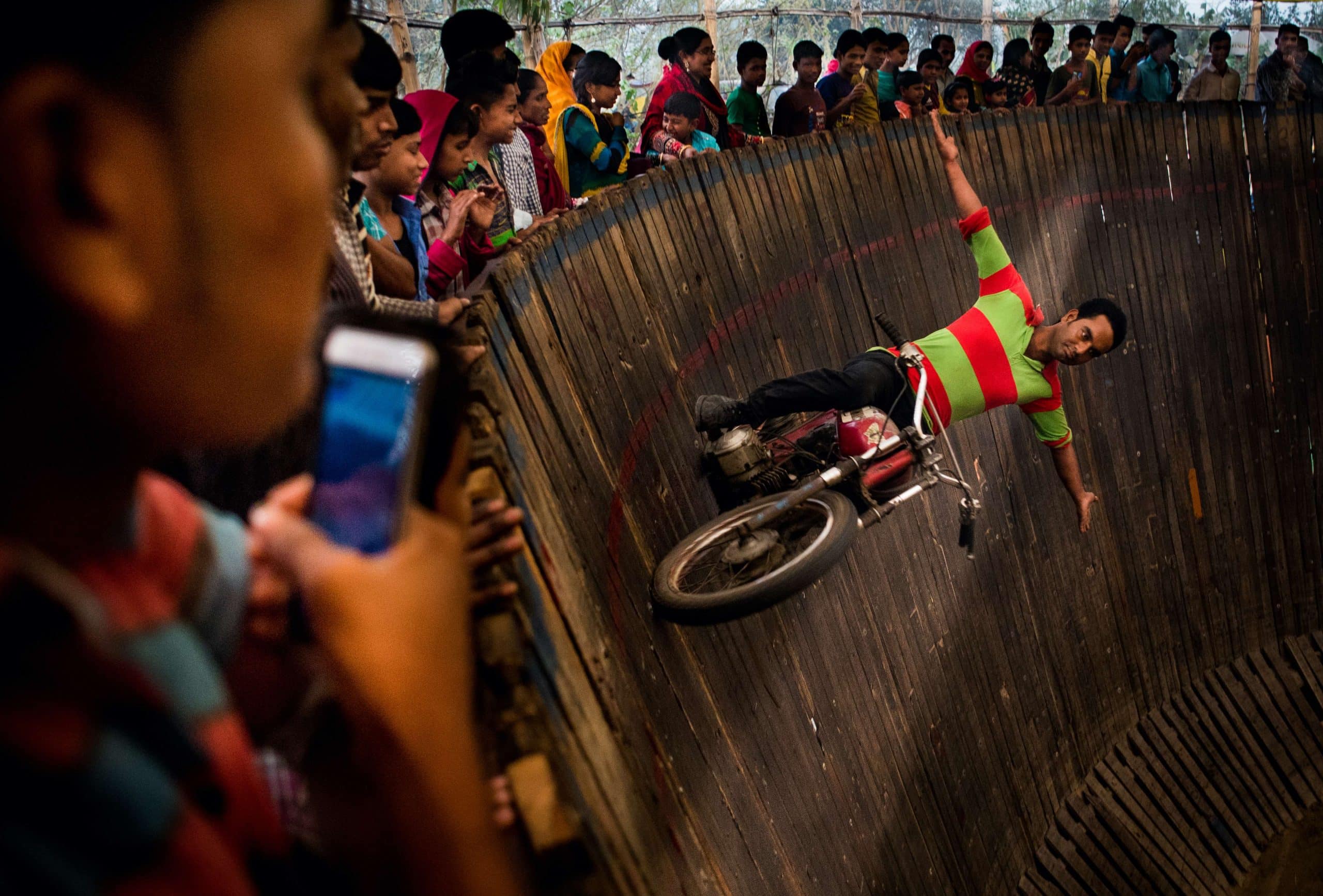
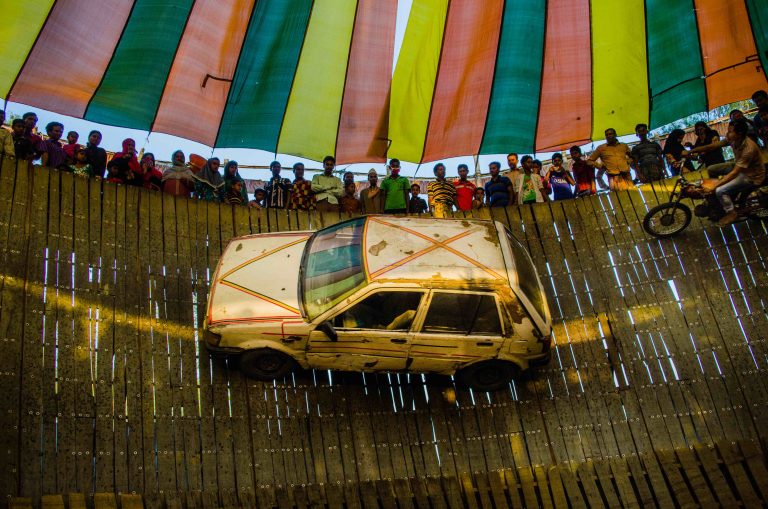
It is loud. The man on the motorcycle kicks the ignition and veers towards the wooden curve of the wall, joining the intensifying thrum of engines already in the drome. It is fast. Corkscrewing upwards into the well, the motorcycle defies gravity as it slides horizontal, pinned to the edge by centrifugal force like a supersonic hamster wheel.
And it is dangerous: any slight movement or collision could send the vehicles crashing down into the centre of the pit. Welcome to the ‘Well of Death’.
… the motorcycle defies gravity as it slides horizontal, pinned to the edge by centrifugal force like a supersonic hamster wheel.
This time we’re in Bangladesh, where Dhaka-based photographer Masfiqur Sohan has been documenting the adrenaline-fuelled carnival act in his eponymous series Well of Death.
Masfiqur began his journey into photography in 2012, joining an Italian photo agency as a freelance press photographer. In the past nine years, he has covered the Rohingya refugee exodus at the Bangladesh-Myanmar border, recorded the impact of climate change on rural communities and photographed on the roofs of passenger trains as they cross Bangladesh’s Bhawal National Park.
Carnivals are an obvious destination for photographers, offering a frenzy of colour, noise and spectacle and of course, nostalgia. As a child, part of the carnival’s magic is in its transience: the way it could materialise overnight—a sparkly oasis of rides, arcades and food stalls—and then disappear just as fast as it arrived. But today their popularity is shrinking.
When Masfiqur noticed how carnival shows like the Well of Death are fading into obscurity in Bangladesh, he made it his quest to document them before they disappear altogether.
… a sparkly oasis of rides, arcades and food stalls …
“Well of Death is a carnival sideshow featuring a well-shaped wooden cylinder, typically ranging from 20-36 ft in diameter and made of wooden planks inside, which drivers and motorcyclists travel along… and perform stunts, held in place by friction and centrifugal force,” explains Masfiqur.
Even if you haven’t experienced the Well of Death firsthand, there’s a chance you will have seen one before. In Roustabout (1964) Elvis Presley stars as singer-bad boy Charlie, who after losing his job hits the road on his Honda 305 Superhawk motorcycle and finds refuge—and eventually work—at a travelling carnival.
After seeing Elvis (or rather, his stunt double) try his hand at the Well of Death in the film, two brothers-in-law were inspired to build their own version in their back garden in Ireland, a true story which resulted in the 1986 comedy Eat the Peach. In The Place Beyond the Pines (2012), Ryan Gosling plays Luke, a stunt rider who performs the ‘Globe of Death’ (which involves a steel cage instead of the classic motordrome) at a touring fair.
The opening scene shows a tattooed, bleach blond Gosling entering the cage on his motorbike. Engines are revved dramatically before the three bikes loop round the impossibly tiny cage like a storm of angry hornets.
… the three bikes loop round the impossibly tiny cage like a storm of angry hornets …
The first truly vertical, motorised Wall of Death is believed to have appeared around 1915 on Coney Island, New York, derived from the U.S. board track racing. From then onwards, as travelling fairs began to incorporate them into their acts, the tracks grew increasingly steep, with vehicles circulating at 60-70 degree banking with coordinated tricks and choreographed ‘races’.
Soon, the stunt show had become a staple in the U.S. outdoor entertainment industry, reaching its zenith in the 1930s. The phenomenon swiftly spread to other parts of the world too, including the UK, and by the mid-1930s, there were 50 such shows touring the country.
Some even featured live animals (most famously a 12-stone lioness named Briton, who belonged to the motorcycling legend Tornado Smith) riding in the sidecars, but its heyday was cut short by WWII when most shows were forced to stop. Although it had a brief resurgence in the 1960s in the UK, the Well of Death has never experienced the same popularity since and just three Walls of Death remain in the UK today.
Bangladesh meanwhile, has a rich carnival and festival tradition, with itinerant performers travelling across the country to bring entertainment to towns and villages beyond the city centres. In fairs like these, the Well of Death has long been a popular fixture after the idea caught on from the U.S.
For his project, Masfiqur visited traditional village fairs in different Bangladeshi districts, where he discovered typical shows such as Pata Khela, Boli Khela, Lathi Khela, Circus, and Mrittu Kup. “‘Mrittu-Kup’ is a Bengal word widely known in Bangladesh as meaning ‘Well Of Death’,” he explains. “I found the performance as the most dangerous and adventurous amongst them.”
While travelling through Panchagarh, Rangpur, Bogura, Gaibandha and Manikgonj, the photographer sought out the touring carnivals—and once he was there, the show wasn’t easy to miss.
Well of Death motorists like to create as much noise as possible to attract an audience to their shows, so the pit is roaring with revving engines before the show has even started.
After paying a small entry fee the spectators cram on to the upper deck, clapping impatiently for the show to begin as the wooden rafters tremble beneath them. The riders then start to circle the bottom of the drum until they gain enough momentum to drive horizontally to the floor. And the show officially begins.
… the performers carry an alarming air of invincibility …
Masfiqur says that the riders sometimes bind their heads in cloth, release their hands from the handle bars, and snatch tips from the audience to add a few extra thrills to their performances.
While they do go in with an awareness of the risks, the performers carry an alarming air of invincibility. These acts can be deadly though, or at the least cause serious injury, especially due to the complete absence of safety precautions.
“Clashes between vehicles is the most common accident they face in the Well of Death,” says Masfiqur. “There is also no protection for the audience. I felt it was risky to take photos (from the top) when I found them performing at the upper side of the cylinder. There are also risks in the ground of the well.”
Once, Masfiqur was taking photos from down below while a car driver and motorcyclist were performing on the wall. Suddenly the motorcyclist hit the back of the car, sending the motorcyclist with his motorbike hurtling towards him.
Fortunately Masfiqur was in a safe place, but there was only 1-1.5ft distance between him and the motorcycle, a very narrow miss indeed.
While the act is often associated with machismo, it is not only men that perform the stunt. Women stunt riders existed in the past, and they still exist today. Among the most well-known from history was Yvonne Stagg, considered to be Britain’s first female Wall of Death star. Even in patriarchal societies like India, female Well of Death riders are more common than they used to be.
But nowadays, Masfiqur tells me that people are losing interest in such carnival shows. In an era of computer games and high-octane action films, people are more likely to seek entertainment online rather than at the fair.
Yet for some Bangladeshis—especially those on lower incomes such as farmers and fishermen—access to the internet is not readily available. In fact, in 2019, just under 13 percent of the population in Bangladesh had access to the internet.
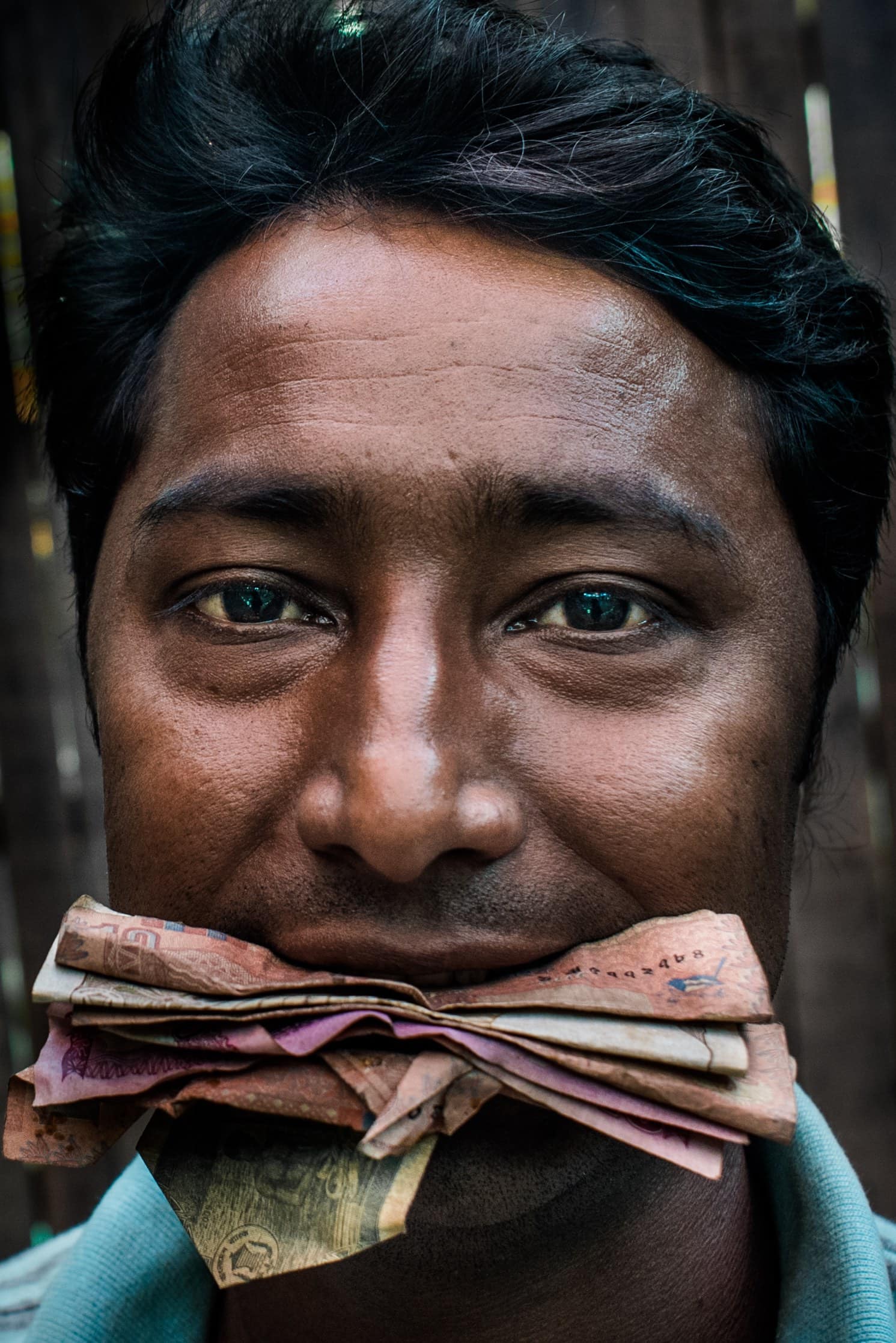
With the dwindling interest, stunt riders and organisers—who largely rely on the shows for their livelihoods—are claiming that they earn less than before. “I found some stuntmen are being engaged with other jobs to survive, as they left performing after not being able to earn enough from the events,” says Masfiqur.
For many stunt riders, they consider what they do an art form—devoting their entire lives to mastering their skill—and it was this commitment that the photographer aimed to convey in the photos. “I tried to capture the passion and the dedication for their performance to show how they are attached to the Well of Death,” he says.
As the future of carnival shows like this hangs in the balance, Masfiqur brings us the smoke, the adrenaline, the thrill, and the visceral experience of seeing and experiencing it with our own eyes (though the irony is you’re probably viewing these images on a screen right now).

