
★★★☆☆
In June, James Blake released ‘Big Hammer’, a bleepy, bass-filled single featuring the legendary Hackney duo The Ragga Twins, which signalled a nod to his FWD>> days and his roots in the hardcore continuum, along with a humorous, heist-themed music video by Oscar Hudson.
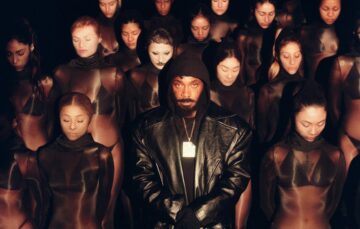
Today, the producer’s sixth album Playing Robots Into Heaven has been released, taking its name from a moment where Blake blended gospel organics and a sequenced melody to form a synth patch; the full-length delves further into the realm of machinic transcendence that the London-born producer has explored throughout his discography.
Blake has been returning to the sonics of his early releases over the last year or so in a partnership with L.A. promoters Rhonda for the CMYK event series, which debuted at HERE in central London last March. Although he’s always continued to make unreleased club tracks for his DJ sets alongside his songwriting, the album has been billed as a return to dance music, ironically concocted during the pandemic’s enforced clubbing hiatus.

Artwork: Thibaut Grevet
Coming from a musical family, Blake was just about old enough to catch the tail-end of the waning jungle and garage scenes as a teenager. After enrolling at Goldsmiths, he began his own night called ‘Bass Society’, which invited the likes of Benga and Skream. Like many involved in the nascent dubstep scene, Blake would send MP3s back and forth with other burgeoning producers, and eventually caught the attention of influential dance music labels Hemlock and Hessle Audio, becoming a key part of the so-called ‘post-dubstep’ sound.
Since these records, Blake has moved further away from his roots in club music; only fragments and snippets reminiscent of these periods are audible in his more recent discography. Over the last ten years, he’s produced choice cuts on Frank Ocean’s Blonde, Kendrick Lamar’s DAMN and Beyonce’s Lemonade, among many other contributions to some of the most influential albums of this period. His dynamic solo output across five albums has won him critical acclaim, a Mercury Prize in 2013 for the singular Overgrown and a Grammy for his work on the Black Panther soundtrack.
Playing Robots Into Heaven begins with ‘Asking To Break’, a signature track filled with solemn vocals, downtempo rhythm and delicate piano melody. The second single, ‘Loading’, sounds like a culmination of all of Blake’s records. Taking a number of structural detours, the track begins with the softly delivered, confessional chorus “Wherever I go / I’m only as good as my mind / Which is only good if you’re mine.” As a 4×4 beat flows in and out, the versatility of Blake’s voice leads frequent changes in tempo, guiding the listener into a dramatic synth outro, showing the producer’s knack for creating all-encompassing harmonies.
‘Tell Me’ is another piece of introspective electro-soul, employing a pumping rhythm and various versions of Blake’s voice. The track never strays from this now one-dimensional formula and ultimately leads nowhere. Blake has always been a devoted acolyte of Burial and ‘Fall Back’ clearly takes inspiration from the enigmatic producer. Crunchy, disconnected drums set the tone before a melancholic melody floats in, followed by Blake’s chopped-up vocals and a lighter, more jazzy finish. The track was recently included in the producer’s Mixmag cover mix inspired by music he’s been playing at his club night, alongside some old favourites from Joy Orbison, Zomby and Airhead.

On ‘He’s Been Wonderful’ Blake shows his fondness for gospel, a sample of Pastor T.L Barret and the Youth for Christ Choir’s ‘Wonderful’ is interspersed by a glitched-out, pop-like trap beat. Together the elements are incongruent and the track sounds incomplete, missing something to tie it all together.
As well as church music, Blake’s sample library has also always included 90s and early 2000s RnB. His breakout 2010 EP CMYK made use of Aaliyah and Kelis. The seventh track on the album, ‘I Want You To Know’, centres around a drawn-out sample from Pharrell’s ‘Beautiful’, “I just want you to know that you are really special,” underpinned by a hollowed-out, dark garage beat.
The combination of pitched-up, serene vocals and disjointed electronic textures is transporting on ‘Night Sky Print’, followed by the two-part ballard ‘Fire The Editor’, which has Blake intermittently repeating the line “I’ve already failed so many times” for a total of nearly eight minutes.
‘Ad Astra’ is more typical of Blake’s recent evocative songwriting. The ambient culmination of the album, ‘Playing Robots Into Heaven’ effectively uses potent chords to create deep feeling. As he recently expressed to Mixmag, “That term, ‘Saying it with your whole chest’… you can do that in music too. You can speak through chords and drums.”

Like many of James Blake’s albums since his acclaimed debut, Playing Robots Into Heaven is a mixed bag. Attempting to strike the perfect balance between a sensitive ballad and a body-moving banger is an unforgiving task, achieved only by the most impressive dance music.
Although Blake has succeeded in perfectly balancing this dichotomy before, he doesn’t quite pull it off here. The album contains all the hallmarks of his previous work – pretty chord progressions, intricate harmonies and experimental flourishes – but aside from some stand-out tracks, at times the subdued mood struggles to capture the imagination.