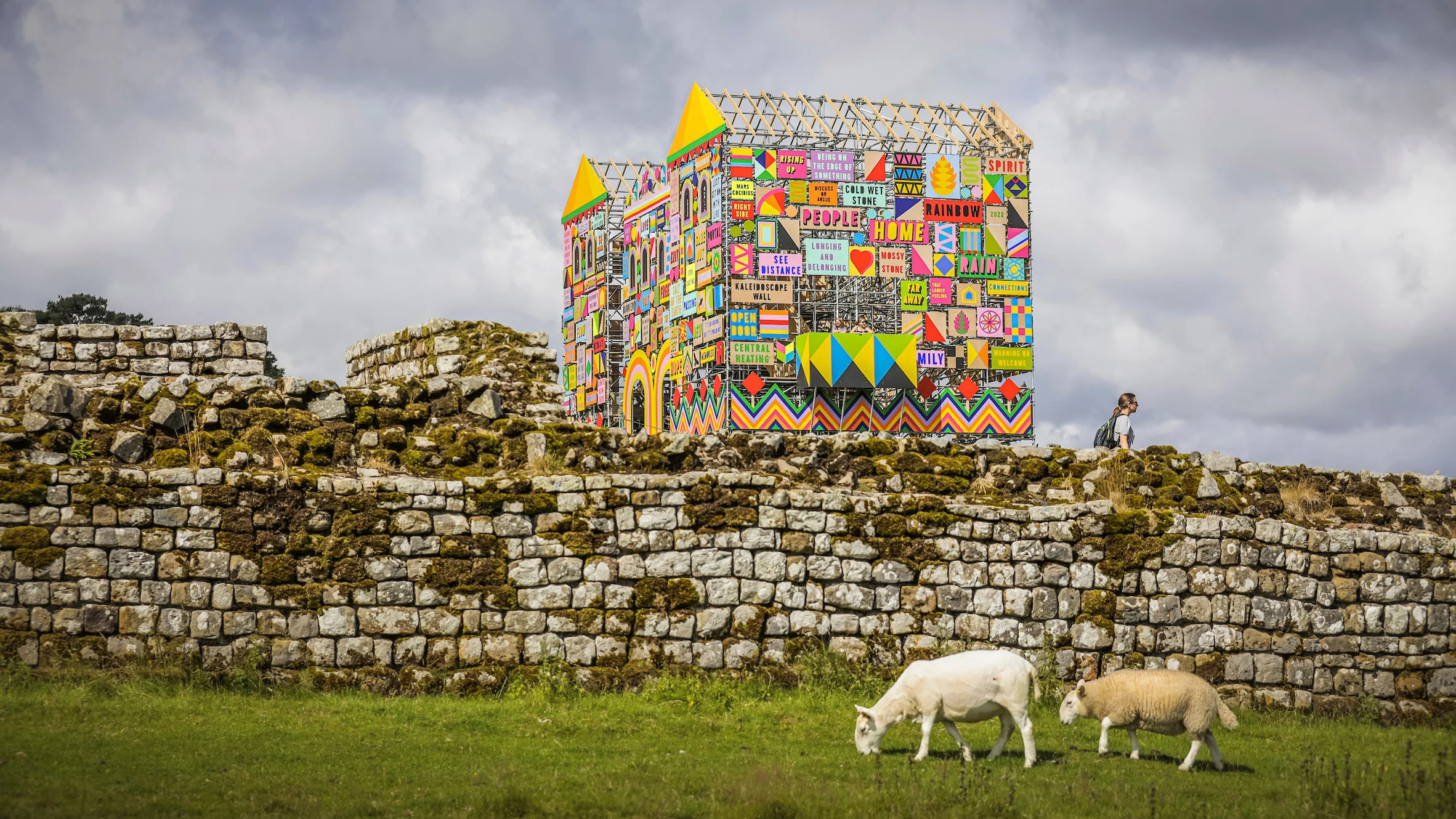
To mark the 1,900th anniversary of Hadrian’s wall, Morag Myerscough has designed an immersive installation at Housesteads Roman fort in Northumberland. It’s certainly eye-catching – but how much does it speak to the past? And what does it tell us about our present moment? Mae Losasso finds out.
Hadrian’s wall, like so many Roman ruins, is grey. Slicing through England, from Wallsend in the east to Bowness-on-Solway in the west, the wall is now nothing more than grey stone stacked upon grey stone, punctuated at intervals by forts built out of grey stone – and all standing beneath an often grey sky.
At least, that’s how we like to picture Hadrian’s wall: no doubt the sun shines there as often as not, but we indulge in the image of moody, blustery skies above the craggy landscape and its grey ruins. And that’s almost how it looked when I visited last week. I say ‘almost’ because, sitting on the peak of the hill at Housestead’s fort, where an impressive north gate once stood, there was a huge scaffolded structure, plastered with brightly coloured placards bearing words, slogans, and loud, geometric patterns. This was not the moody vision of Hadrian’s wall that I was expecting.
The installation, ‘The Future Belongs to What Was As Much As What Is’ by contemporary artist Morag Myerscough, was commissioned by English Heritage and unveiled on Saturday to mark the 1,900th anniversary of the wall. Myerscough, who is known for her bold, Memphis-style designs, anticipated the possibility that her installation might not be to everybody’s taste. As she commented in an interview with the Guardian: ‘It’s not whether people like something, or they don’t like something … if they start talking about it then that is very exciting. It’s about being surprised by something’.
Myerscough was right to predict mixed responses, but not necessarily for the reason she thinks. No, it’s not the bright colour that I mind, because although it does jar with the grey aspect, I like the intentionality: Myerscough deliberately created a bright installation to connect past and present by reminding us that Romans themselves loved a bit of colour. Their monumental buildings were not, as we often think, white (or grey) and austere, but adorned with paint and hung with colourful drapery.
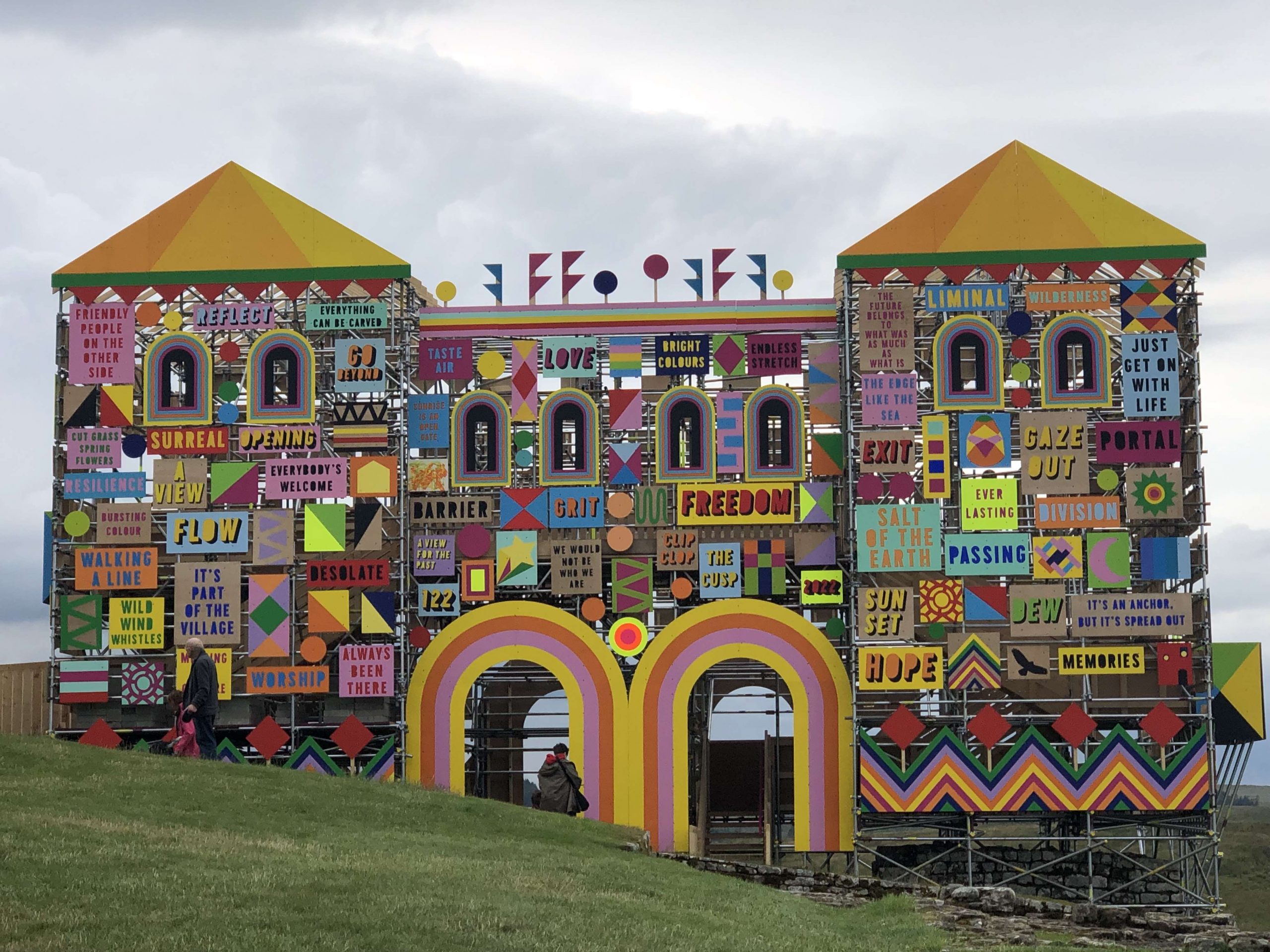
Taken by Mae on her smartphone. Unlike the top image, this one hasn’t been edited and has no filter.
It’s not even the scale that I take issue with. Yes, it may be a controversial choice, since it dominates the low-lying remains of the ancient fort, but I applaud the way it mixes contemporary installation with historical reconstruction. Standing at 8.5 metres high by 12.5 metres wide, the structure replicates the original Roman gatehouse, giving viewers a sense of just how impressive the fort would have been, while the interactive nature of the scaffold means that viewers can gain the vantage point of a Roman soldier, patrolling the wall on the lookout for wayward Picts.
And even though Myerscough’s design is not to my own taste, I’m even fine – in theory – with its modern style. After all, English Heritage commissioned a work of contemporary art not a historical reconstruction. So what is my aversion to the structure? The very thing that claims to make this work a dialogue: the words and phrases bolted on to the scaffold.
‘Hope’, ‘Liminal’, ‘Baking’, are the first words that loom into view as I climb the hill towards the installation. I’m particularly struck by ‘liminal’, a word that everybody seems to love right now for its, well, liminality: it’s not quite here, it’s not quite there; it marks a boundary while simultaneously transcending it; it alludes to the tantalising possibility of occupying two positions at once. But it also says nothing at all, precisely because it has become a buzzword, a catch-all for everything that isn’t anything. As for baking, the less said about that the better: the word is now so smeared with the sticky residue of The Great British Bake Off that it oozes a kind of smug, apron-wearing sense of domestic satisfaction.
Perhaps I should be less cynical and more generous – especially given that these placards represent a plethora of local voices: Myerscough worked with community groups to develop the words and phrases that adorn them. Like the colour and scale of the piece, I like this inclusive approach in theory, but I am dismayed by the final piece because it reveals the bubble of our present moment, our inability to look back to the past, and the extent to which we’ve moored ourselves in the contextless sea of now. Our desperation to make the past cool, colourful and contemporary means that we often blot it out altogether, such is our fear that younger generations just won’t be interested in boring old grey ruins. But that does a disservice, both to the power of the past and to young people, who don’t need to be coaxed into looking at history with a big, instagrammable bowl of buzzword soup.
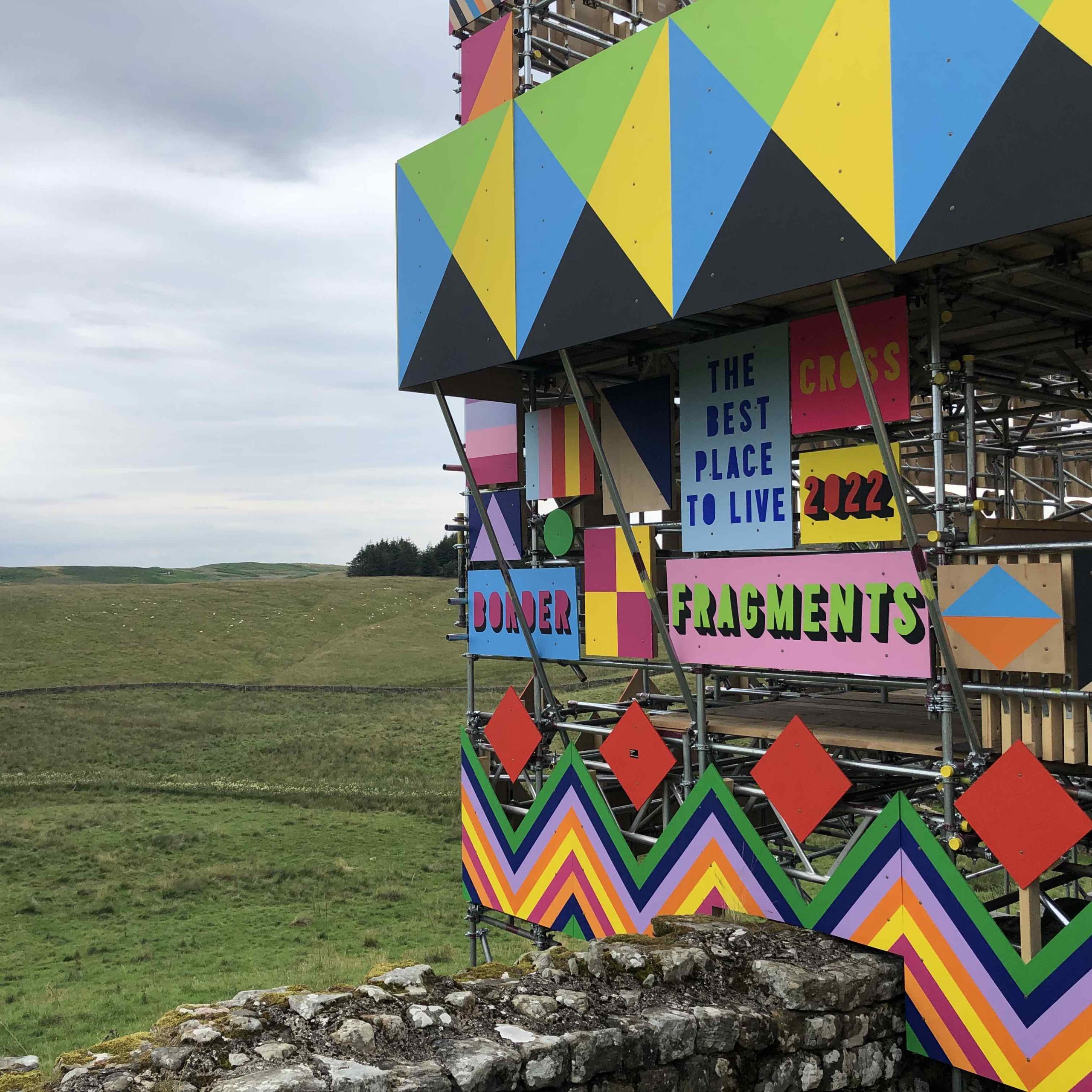
What is more, I can’t help but feel that divorcing words from their context to hang, like baubles, on the festival scaffold captures the most reductive impulses of contemporary society. These little placards have none of the revolutionary zeal of protest signs, and they don’t speak to history: they’re caught in the bubble of the present, where words have become images, like stylish little instagram blocks, no longer signifying anything beyond themselves.
Our craze for motivational or uplifting words and phrases like ‘Hope’ or ‘Everlasting and Strong’, isn’t only unchallenging, it also robs words of their political or transcendent power. What could have been a bridge between past and present is more like the vallum, or ditch, dug around Hadrian’s wall to entrench a divide. Perhaps if she’d looked a little closer at the language of our Roman ancestors, Myerscough might have learned from the Latin phrase acta, non verba: actions, not words.

1 Comment
An excellent piece of journalism, recognising yet dismissing (quite rightly), the ‘other’ point of view. Speaking as one who was shocked at the presence of the millstone paving slabs on other parts of the Pennine Way, I would have been horrified to meet this misplaced monstrocity, and raced off back towards to the tranquillity of nearby Wark Forest.